The Blog

How I Chose to Say Farewell to IE6

attention_ie6

The web community has been abuzz lately with talk about dropping support for IE6 and rightfully so! I couldn’t agree more for most sites, though I’m sure there will be the occasional client who either requests IE6 to be included in testing or it turns out their audience actually does use IE6 according to the site’s stats. Nonetheless, the majority of mordern websites could certainly do without supporting IE6. I would guess somewhere between 30% of my development time is spent fixing the crippled browser, if not more, and I’m looking forward to an enormous decrease in frustrations! It was always a frightful thing to fire up Windows and find out what horrors IE had done to a perfectly good site. I don’t blame the browser either; the problem was for too long (way too long) IE6 still had a large user group. Thankfully, those numbers are continually decreasing and I’ve decided this is the year I’ll be dropping support for IE6. If a future client requests the browser to be supported, that’s fine, but it will come at additional costs for the extra development and testing time.

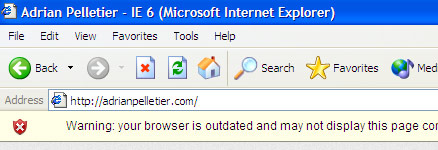
As for how I’m going to ignore the outdated browser, I wanted to notify IE6 users of the issue rather than assume they already knew they were using an outdated browser. My solution was to create a warning message that gets inserted after the opening <body> tag via Javascript. Conditional comments ensure this message (as well as the HTML code within the body) will only appear for IE6 or previous versions. The message is styled in a very Microsoft-esque way so even the hardest-core IE6 user will be able to recognize it. :) Where does the link point to? Firefox, of course.

This site is currently using what I’ve dubbed the “Attention IE6″ script so go ahead and open IE6, then visit www.adrianpelletier.com. I’ve configured the script to work in conjunction with jQuery because that is the framework I was already using but I’m sure you could easily adapt it to fit your own needs. I’m posting a download link for anyone who cares to use this approach on their own website. The setup is very simple, just include the following conditional comment in the <head> of your document.

1
2
3
4
5
<!--[if lte IE 6]>
    <link rel="stylesheet" type="text/css" href="css/ie6.css" media="screen" />
    <script type="text/javascript" src="js/jquery.min.js"></script>
    <script type="text/javascript" src="js/attention_ie6.js"></script>
<![endif]-->

Next, download the following files and place in the appropriate Javascript, CSS, and images directories:

Download

And so, farewell to IE6. I cannot say that I will miss you.

Update 05/31/2009: I want to emphasize that this experiment is not a fix-it-all solution by any means. As stated above, a large majority of modern websites would have no problems dropping support IE6. For example, this site currently receives around 3% of users on IE6 and that number continues to drop. That’s not a large enough audience to worry about, in my opinion. There are, however, still specific scenario’s where IE6 maintains a much higher user percentage (i.e. corporate businesses that place restrictions on browser updates). In those cases, I do believe IE6 should be included in development testing.

I also do not advocate blocking or punishing IE6 users. My intentions with the above approach were to 1) inform the user that they are using outdated technology and 2) warn that the site may look as it should. However, I have not restricted the user’s access to the site’s content and would never recommend doing so.

I don’t consider this article to be the final answer, not by a long shot. However, I would hope that ideas such as these will at least strike up conversations and thoughts about advancing web development and what the next step should be.

18 Comments

Feel free to join the discussion! Leave a Comment

  1. Andrew says:

    Great stuff.

  2. Kyle says:

    Nice work Adrian :)

  3. Thanks for sharing this, I wholeheartedly agree with the need for users to update their browsers! Thanks for sharing your script.

  4. LWS says:

    Very nice, but the close action must doing what is supposed to do, I don’t think it is necessary to mislead the user. Oh btw Adrian, I discover your blog via Twitter and really love your work.

  5. Jamie says:

    Thanks a bunch!

  6. Adrian says: (Author)

    @LWS: I do agree. When I first created the script, my goal was to create a link to a better browser for IE6 users and the close icon was mainly for design to help pull off the Microsoft look. However, I am already planning on creating updated versions of this script which will offer a functional close button and other enhancements.

    Thanks, everyone, for the feedback.

  7. Geoff says:

    Very nice pro-active solution to the problem. Thanks!

  8. Zac says:

    Let me know when the updated version comes out!

  9. Adam says:

    Adrian, this is great. I’ve implemented some similar techniques, but really like how you’ve made it look like some kind of IE6 style error message, and even send the visitor to mozilla if they click the X! I like it so much I think Im going to show it to visitors on ANY version of IE! :)
    -Adam

  10. Arthur Brown says:

    This is a good solution. I am hopeful that more and more people will begin to use this as I am hopeful that IE6 will pass on in the annals of history. Thanks!

  11. Prashant says:

    Yes, some one has to show hand to the crippled browser. with mozilla’s nightly builds supporting more and more of CSS3 feature letting developers explore the wed to heart’s content though not for general use, but it has made web pages much smaller and controlled. Let MS keep up to the pace or face the music. But for now the visitor to the site would be on the loosing side. We should also encourage them to switch to more sophisticated browsers for better and faster web experience. Keep up. !!

  12. Alexander says:

    Hello Adrian,

    your script is a great idea and very well crafted! We should give it a try… and check out by user statistics if this thing really works on IE 6 users and pushes them to where we want them to have. I think the problem with IE 6 has it´s cause less in the stubbornness of the individual user; here in Germany we have the problem that espacially bigger companies follow a very restricted policy in their information technology, and for the most part the employees are not allowed to update anything on their pc´s without permission. So many companies don´t bother if they are using old browsers, after the motto: What worked well in the past should not be changed! I have encountered such ignorance in this matter (i mean ignorance about the fact that outdated browsers render sites incorrectly), you wouldn´t believe it! So many people wouldn´t see no vital reason to have their it-specialists to update these ancient browsers.

    Believe it or not it is only two years ago that i worked on a freelance job in a big advertising agency making company brochures (so nothing to do with the web), and there i just installed firefox on a pc (every workplace had a mac and a pc for whatever reason). Next thing was i got a lot of trouble with the man in charge for the hard- and software for installing our beloved browser! His argument was: “Man, this browser has got serious security issues!! To install it in our environment is an absolute no go!!” This was ridiculous, even two years ago, as there were other IT-companies i knew that used FF naturally. So this man didn´t know the first thing about browsers. And he was reluctant to update his knowledge completely. Poor people..
    So i think your script will be a great help with “private” users and their home computers. But i´m in doubt as it will be a help with companies – at least in my country.
    Greetings
    Alex

  13. Adrian says: (Author)

    I appreciate the continued input. Thanks!

    @Prashant: CSS3 is very exciting and developers are finally getting the chance to use some some of its capabilities in browsers like Firefox. Check out the latest 3.5 release available for testing right now. IE6 becomes more outdated each day.

    @Alexander: As much as I believe now is the time to drop IE6, I do realize that there are still some rare cases where IE6 will be required, whether by client request or because the site’s target audience still has a large percent of IE6 users. That is why I did not choose to create an IE6 landing page or other method that completely locks out IE6 from accessing the website. My intent was to inform IE6 users that they are using an outdated browser and supply an alternative solution without restricting access to the site.

  14. Macrike says:

    Very nice. I done something like this a couple of years ago, and all of a sudden 90% of our outbound links were to Mozilla. Lost the script, but lucky I found you’re one.

  15. Zafar Majid says:

    I’ve spent hours trying to get things to look right in IE 6… and would gladly support not having to bother.

    But…. lots of people still use it!

    I understand that approx 30% still use IE 6, we can’t just abandon those people… especially if some of them are your clients.

    Anyway, there are lots of fixes for IE 6 out there.

    Chin up, grin and bear it.

    Zafar

  16. Adrian says: (Author)

    Zafar, the percent of IE6 users greatly varies from site to site. I agree that a site receiving 30% of its traffic from IE6 users should continue to develop for that browser. However, there are countless other sites and businesses that do not attract that large of an IE6 audience and would have no issues dropping support for the outdated browser.

  17. Kent says:

    That’s a pretty slick solution to a far too common problem. I love how you sort of trick the user into thinking it’s a message from Microsoft and give them a message they can’t miss. I’ve found that putting a simple, discrete message on the page often doesn’t cut it.

  18. Greycoat says:

    I’m not fan of the EU, but the EU requires pointing to a selection of browsers when one install Windows. Instead of pointing exclusively to Microsoft’s latest browser or exclusively to FireFox as you have done, why not point them to this link:

    http://www.browserchoice.eu/BrowserChoice/browserchoice_en.htm

    Give them the freedom of “choice”.

Comments are now closed for this article.